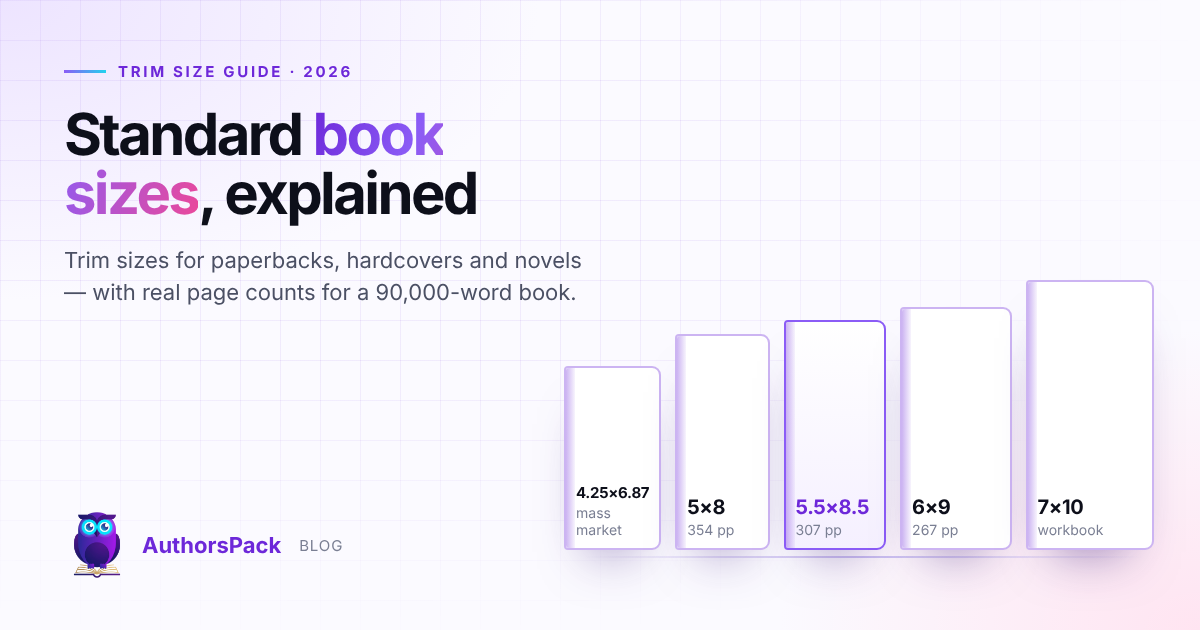
The most common book sizes are 5.5 × 8.5 in and 6 × 9 in for trade paperbacks, 5 × 8 in or 5.25 × 8 in for many novels, and about 4.25 × 6.87 in for mass-market paperbacks. Hardcovers are usually 6 × 9 in or 6.14 × 9.21 in. Nonfiction most often uses 6 × 9 in, and workbooks 7 × 10 in or 8.5 × 11 in.
Trim size is the first production decision you make, and almost everything else follows from it: how many words fit on a page, how many pages the book runs to, how thick the spine is and what each copy costs to print. This guide gives the standard sizes used by trade publishers and print-on-demand platforms, explains which size suits which kind of book, and shows how much the choice really changes a finished book — using measured results, not estimates.
Standard book sizes at a glance
These are the sizes you will see on bookshop shelves and in the trim lists of Amazon KDP and IngramSpark. Sizes are given width × height.
| Format | Inches | Millimetres | Typically used for |
|---|---|---|---|
| Mass-market paperback | 4.25 × 6.87 | 108 × 175 | Rack-sized genre fiction, reprints |
| Digest / small trade | 5 × 8 | 127 × 203 | Novels, novellas, poetry, memoir |
| Trade paperback | 5.5 × 8.5 | 140 × 216 | The most common size for adult fiction and memoir |
| US trade | 6 × 9 | 152 × 229 | Nonfiction, long fiction, fantasy, business |
| Royal | 6.14 × 9.21 | 156 × 234 | Hardcovers, literary and history titles |
| Large trade | 7 × 10 | 178 × 254 | Textbooks, workbooks, illustrated nonfiction |
| Letter | 8.5 × 11 | 216 × 279 | Workbooks, manuals, journals |
What “trim size” means
Trim size is the final size of the page after the printed sheet is cut. It is the number you choose when you set up a print book, and the size your interior PDF should be — unless your book has artwork running to the edge of the page.
That edge-to-edge artwork is called bleed. On KDP, an interior with bleed is supplied 0.125 in wider and 0.25 in taller than the trim, so a 6 × 9 in book becomes a 6.125 × 9.25 in PDF; the extra is trimmed away. A text-only novel needs no bleed at all.
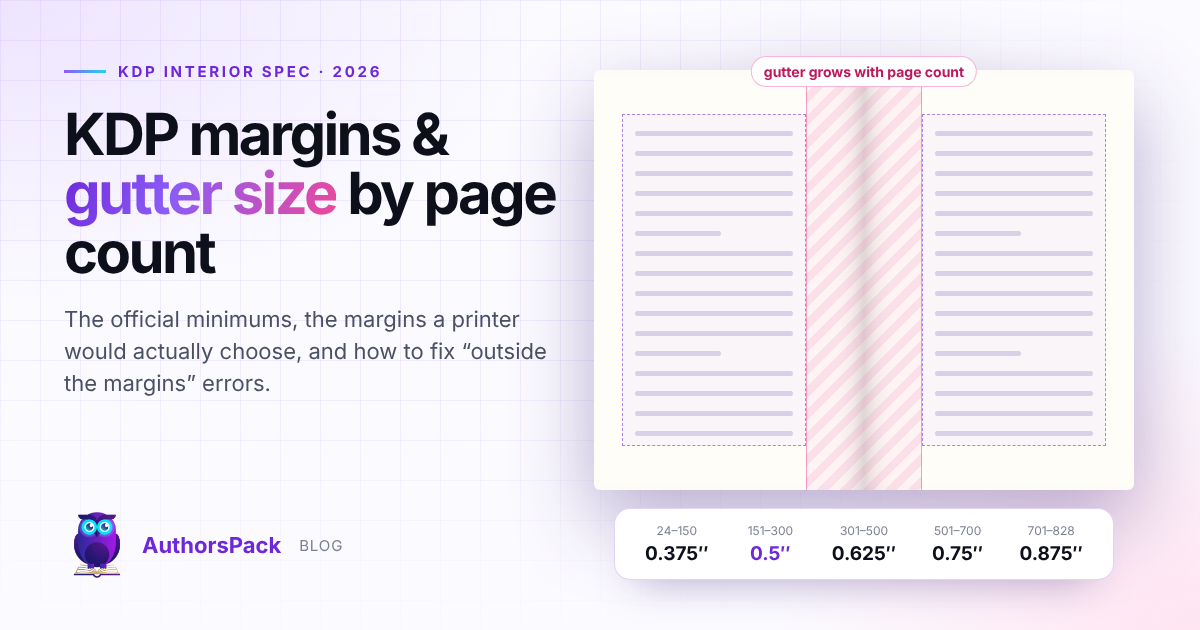
The page is not the same as the area your words occupy. Margins take roughly 0.5–0.9 in on each side, so a 5.5 × 8.5 in page carries a text block of about 4.2 × 7 in. Margins are set by page count — see our guide to KDP margins and gutter size.
Book sizes by genre
Readers notice when a book is the wrong size for its shelf, even if they could not say why. Genre conventions exist because they match how each kind of book is read.
| Genre | Usual trims (in) | Why |
|---|---|---|
| Commercial fiction (thriller, romance, mystery) | 5 × 8, 5.25 × 8, 5.5 × 8.5 | Easy to hold, comfortable line length, matches trade shelves |
| Literary fiction | 5.5 × 8.5, 6 × 9 | A more generous page; 6 × 9 for long novels |
| Fantasy and science fiction | 6 × 9, 5.5 × 8.5 | Long word counts — the larger page keeps the book from becoming a brick |
| Memoir | 5.25 × 8, 5.5 × 8.5 | Personal, novel-like reading experience |
| Business, self-help, how-to | 5.5 × 8.5, 6 × 9 | Room for headings and lists; 6 × 9 is the nonfiction default |
| Textbooks and workbooks | 7 × 10, 8.5 × 11 | Space for diagrams, tables and writing room |
| Middle grade and chapter books | 5 × 7.5 to 5.5 × 8.5 | Smaller hands, larger type |
| Poetry | 5 × 8, 5.5 × 8.5 | Lines need width; short collections stay slim |
Paperback sizes: mass market vs trade
There are two kinds of paperback. Mass-market paperbacks (about 4.25 × 6.87 in) are the small, cheaply printed editions sold in supermarkets and airports, usually issued after a hardcover or trade edition. Trade paperbacks are larger and better made, and they are the standard for self-published and independent books — almost always 5 × 8, 5.25 × 8, 5.5 × 8.5 or 6 × 9 in.
If you are publishing independently, choose a trade size. Mass-market economics depend on very large print runs, and print-on-demand pricing makes the small format a poor deal per page.
Hardcover sizes
Hardcovers are usually 6 × 9 in or 6.14 × 9.21 in, with 5.5 × 8.5 in used for smaller fiction. On KDP, hardcovers are available at 5.5 × 8.5, 6 × 9, 6.14 × 9.21, 7 × 10 and 8.25 × 11 in, for books of 75 to 550 pages. IngramSpark offers case-laminate and cloth-with-jacket editions at 5.5 × 8.5, 6 × 9 and 6.14 × 9.21 in, among others.
KDP and IngramSpark trim sizes
KDP splits its paperback sizes into regular and large. A size is large if it is wider than 6.12 in or taller than 9 in; large trims cost more to print.
| KDP paperback | Sizes (in) |
|---|---|
| Regular | 5 × 8, 5.06 × 7.81, 5.25 × 8, 5.5 × 8.5, 6 × 9 |
| Large | 6.14 × 9.21, 6.69 × 9.61, 7 × 10, 7.44 × 9.69, 7.5 × 9.25, 8 × 10, 8.25 × 6, 8.25 × 8.25, 8.5 × 8.5, 8.5 × 11, 8.27 × 11.69 |
Page limits depend on the trim, paper and ink. For black ink, which covers nearly all novels and nonfiction:
| KDP trim group | White paper | Cream paper |
|---|---|---|
| Most sizes (5 × 8 to 8 × 10) | 24–828 pages | 24–776 pages |
| 8.25 × 6 and 8.25 × 8.25 | 24–800 pages | 24–750 pages |
| 8.5 × 8.5 and 8.5 × 11 | 24–590 pages | 24–550 pages |
| Hardcover (all sizes) | 75–550 pages | 75–550 pages |
IngramSpark's paperback list overlaps heavily — 5 × 8, 5.5 × 8.5, 6 × 9 and 6.14 × 9.21 in among them — and adds sizes KDP does not, such as 5.83 × 8.27 in (A5). If you plan to distribute through both, pick a size both platforms offer so one interior works everywhere.
How trim size changes page count, spine and cost
To measure the effect rather than guess it, we typeset the same 91,490-word, 37-chapter novel on the AuthorsPack Formatting Press at four trim sizes, keeping everything else identical: same typeface, same size, chapters opening on a new page, margins set to clear KDP's minimums.
| Trim | Literata 10.5 pt | EB Garamond 11.5 pt | Spine (cream)* |
|---|---|---|---|
| 5 × 8 in | 354 pages | 311 pages | 0.89 in |
| 5.25 × 8 in | 345 pages | 307 pages | 0.86 in |
| 5.5 × 8.5 in | 307 pages | 271 pages | 0.77 in |
| 6 × 9 in | 267 pages | 233 pages | 0.67 in |
Calculating spine width
KDP calculates spine width as page count × paper thickness: 0.002252 in per page for white paper, 0.0025 in for cream and 0.002347 in for premium colour. A 300-page novel on cream paper therefore has a spine of 0.75 in. KDP allows spine text only from 79 pages.
What font size books use
Trade books are usually set between 10.5 and 12 pt, with line spacing about 130–145% of the type size. The right size depends on the typeface — fonts with a large x-height read larger at the same point size — and on the trim: smaller pages usually take the lower end of the range. Middle grade and chapter books go up to 12.5–13 pt. KDP's technical minimum is 7 pt, which is only suitable for small print such as captions.
How to choose your trim size
- 1Start from your genre
Pick from the conventional sizes for your shelf in the table above; readers and retailers expect them.
- 2Check your word count
Under about 45,000 words, a smaller trim makes a fuller-feeling book. Over about 110,000 words, 6 × 9 in keeps the page count and spine manageable.
- 3Confirm the platforms
Choose a size offered by every platform you will use — 5 × 8, 5.5 × 8.5, 6 × 9 and 6.14 × 9.21 in work on both KDP and IngramSpark.
- 4Consider a hardcover
If you plan one, choose a size that is also a hardcover trim (5.5 × 8.5, 6 × 9 or 6.14 × 9.21 in) so the editions match.
- 5Typeset before you design the cover
The spine width comes from the final page count, so the interior has to be finished first.
Sources
- Set Trim Size, Bleed, and Margins — Amazon KDP Help
- Paperback Submission Guidelines — Amazon KDP Help
- Cover calculator and spine width — Amazon KDP Help
- Available Trim Sizes, Bindings for Covers, Interior Papers for Print Books — IngramSpark Help Center
- Standard Book Sizes: A Guide for Authors — Reedsy
Page counts and margins marked “AuthorsPack measured data” were produced by typesetting a 91,490-word, 37-chapter test manuscript on the AuthorsPack Formatting Press in October 2026.